Guides
Garage door technician certification in Ontario: the rules
Garage door technician certification in Ontario is not a single license. Working at Heights training, TSSA scope and trade rules apply to different tasks.
What to take away
- Garage door technician certification in Ontario is not a single licence: Ontario issues no provincial licence for garage door installers, and several separate rules apply. Which ones bite depends on the task and the building.
- Working at Heights training under O. Reg. 297/13 is mandatory for anyone working at height where fall protection is required, and the training record must be kept.
- TSSA regulates fuels and certain elevating devices, not residential garage doors, so a TSSA licence is not the credential most installers need.
- The Trades Qualification and Apprenticeship Act is the statutory basis for trade certification in Ontario, and general construction is a voluntary certified trade.
- Skipping the training or the notification can produce an order, a stop-work direction and a fine, not just a paperwork note.
Who has jurisdiction over the work
Four layers decide whether a job is legal. The province sets occupational health and safety duties, including fall protection, and the municipality issues building permits and enforces the Ontario Building Code locally.
TSSA oversees fuels, boilers, pressure vessels, and elevating devices. A property owner or private standard, such as a commercial warranty or insurer condition, can add requirements on top.
That split matters because a US article about state contractor licences answers none of it. Ontario has no state-level garage door installer licence. What it has is a set of duties attached to the work itself.
Working at Heights training and when it applies
Under Ontario Regulation 297/13, a worker who uses specified fall protection equipment must complete Working at Heights training approved by the Chief Prevention Officer. The training must be refreshed every three years. Employers keep the records and produce them on request.
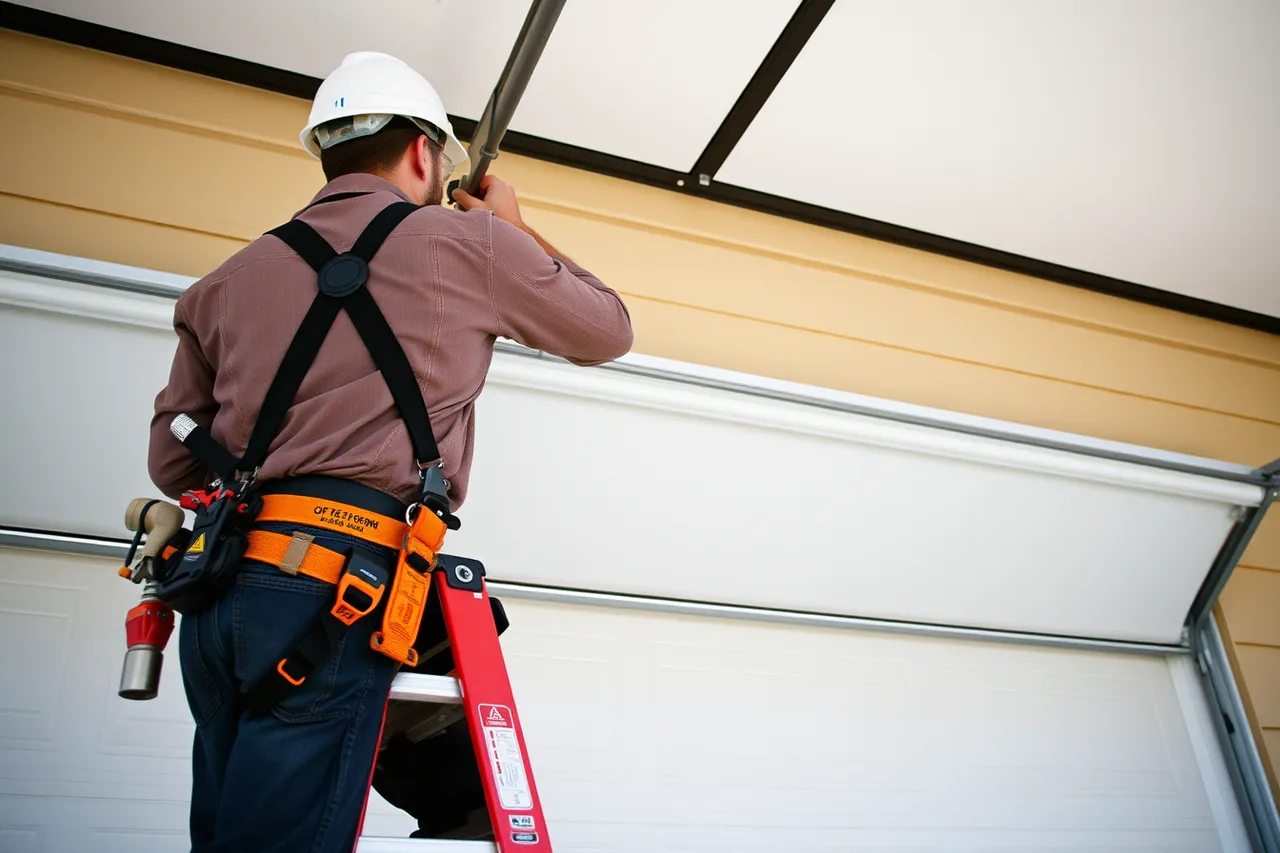
Garage door work triggers this often. A technician on a ladder above three metres, a crew on a low-slope commercial roof, or anyone at an unguarded edge needs the training and a fall protection plan. The Ministry of Labour, Immigration, Training and Skills Development can order work stopped where the training is missing.
A missing training record is treated as no training at all. The certificate is the evidence, not the memory of the course.
Training must come from a provider on the Chief Prevention Officer's approved list. Ontario's health and safety associations, such as the Infrastructure Health and Safety Association (IHSA), are among the approved trainers, and the employer keeps the certificate on file.
Trade classification and the apprentice route
Ontario's trade rules sit in the Trades Qualification and Apprenticeship Act, and Skilled Trades Ontario is the provincial regulator that administers trade certification and apprenticeship registration. General construction is a voluntary certified trade in Ontario, which means certification is available but not required to work. Employers who want to train an apprentice register through Skilled Trades Ontario, and the federal side supports mobility and Red Seal recognition through apprenticeship services.
There is no compulsory garage door installer licence in Ontario. The practical result is that a homeowner cannot check a provincial register for a door installer, so the employer's own training record carries the weight.
What triggers a permit or notification
| Situation | Typical trigger | Who to check with |
|---|---|---|
| Replacing a door in a detached home | Same size, same opening | Local building department |
| Cutting or widening a header | Structural change | Local building department |
| Commercial rolling door with a fuel-fired unit heater nearby | Fuel work | TSSA-licensed contractor |
| Any work at height | Fall protection duty | Employer and Ministry |
| New electrical circuit for an operator | Electrical work | Licensed electrical contractor |
Check the local building department before quoting. Requirements differ between Toronto, Ottawa and smaller municipalities, and a permit condition can change the schedule.
Documents an application needs
- A site plan or drawing showing the opening, the door and the header.
- Manufacturer specification sheets for the door and operator, including the model number.
- Proof of the contractor's insurance and, where required, WSIB coverage.
- The Working at Heights training record for each worker on site.
- Electrical drawings where a new circuit is added.
- Confirm the door size matches the existing opening.
- Confirm the operator has a current safety listing.
- Confirm training records are on file before the crew arrives.
What shapes the approval time
Timelines vary by municipality and by completeness of the submission. A straightforward residential door replacement in a municipality with an online portal can clear in days. A structural change or a commercial project with a fire separation review can run weeks. Treat any figure as illustrative and confirm with the local office, because a resubmission restarts the clock.
What happens if you skip it
This part costs the most. A technician at height without valid Working at Heights training can be ordered off site. The employer can face a stop-work order and a fine under the Occupational Health and Safety Act.
A door installed without a required permit can be ordered removed or brought into compliance, and the owner may have to pay twice.
There is a second consequence that stays hidden. An unpermitted installation can surface during a home sale, an insurance claim or a warranty dispute, months after the crew has left. The paperwork problem becomes the homeowner's problem, and then the contractor's.
Parts side: sourcing decisions interact with these rules, and cross-border parts sourcing for Canadian trucks explains what changes at the border. Equipment side: CSA and NBC rules for automatic operators covers standards for the operator itself.
When a customer decides repair or replace, the opener repair versus replace guide gives the service owner a way to frame the call. For the crew, a garage door service team training checklist keeps the records in one place.