Guides
Garage Door Service Hiring and Technician Training
Garage door service hiring works best with a clear selection process, supervised training, safety sign-offs, compliant onboarding, and retention planning.
What to take away
- Almost nobody arrives trained for this work. You are building the technician, which means your training system is your hiring strategy.
- Training walks out of the building. Accept that, and decide what you do about it before it happens rather than after.
- Dispatch by sign-off, not by availability. What a person may be sent to alone should be a written list with dates on it.
- The riskiest work in this trade is not the work people find hardest. Set your rule about who does it, and why, in writing.
- Pay, hours, and consistency in hiring are governed by rules you do not get to design. Learn them before the first offer, not after the first dispute.
The training problem that defines this trade
Garage door service hiring rarely starts with a large pool of qualified garage door technicians. Most shops recruit from adjacent trades or from outside the trades entirely, and then teach the work on the vehicle. That has three consequences an owner should plan around.
First, your capacity to grow is limited by your capacity to train, not by demand. Second, the person doing the training is your most productive technician, so training costs you the output of your best worker. Third, the training is portable. Once someone can service doors competently, they can take that anywhere, including into business for themselves down the road.
None of this is a reason to train less. It is a reason to train deliberately, record what has been signed off, and make staying worth more than leaving.
Dispatch by sign-off, not by availability
The single most useful document in a growing shop is a grid: people down one side, work types across the top, and a date in each cell where that person has been signed off to work unsupervised. Dispatch reads that grid.
Sign-off grid benefits
What it does
- Stops unsupervised work
- Prevents injuries and callbacks
- Shows thin bench
- Can be planned against
- Gives visible path
- New hire sees progress
- Answers insurer
- Who was permitted to do what
- Disciplines schedule
- Flags single-person jobs
Why it matters
- Stops unsupervised work
- Shows thin bench
- Gives visible path
- Answers insurer
- Disciplines schedule
The grid also disciplines the schedule. A job that only one person can take is a scheduling risk, and the grid makes that visible before the day it matters. That connects directly to the dispatch design in the operations and workflow guide.
The work that needs its own rule
Some of this trade carries serious injury risk, especially work on the counterbalance assembly, which is under load whenever the door is down. Do not invent a technique.
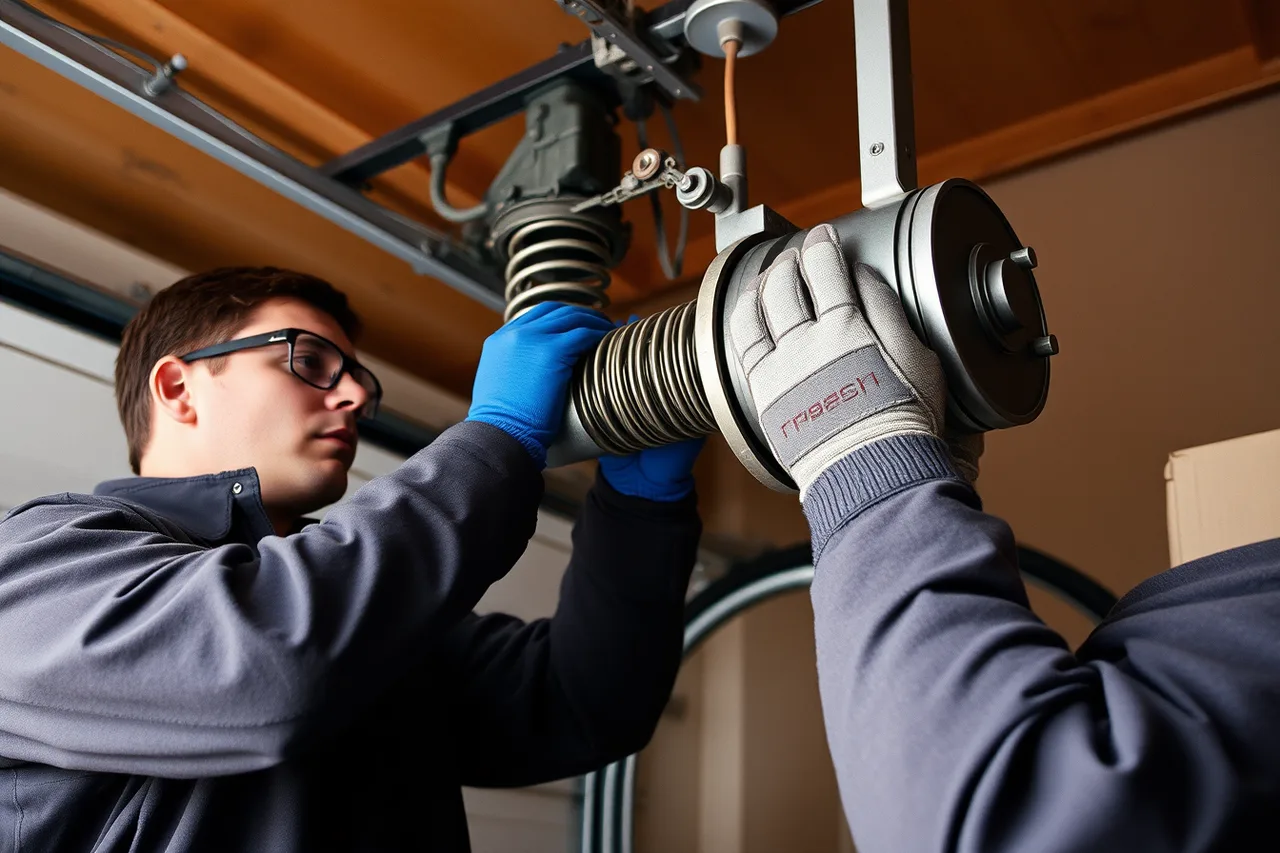
As owner, decide in writing who may do that work, under what supervision, and with what equipment. Treat the manufacturer's instructions for the specific product as the authority and your insurer's conditions as a constraint.
Shops differ. Some require a second person present for particular tasks; others do not. A well-run shop decides, explains the reasoning, and trains to that decision.
Build the written program from OSHA's Recommended Practices for Safety and Health Programs and applicable requirements in 29 CFR Part 1910. Treat these as a starting point, not a replacement for the manufacturer's instructions, state requirements, or insurer's conditions; confirm what your state and insurer add.
Where the people come from
Arrives with
- Another mechanical trade
- Tool sense and diagnostic habits
- Adjacent home services
- Customer skills and route discipline
- No trade background
- Attitude and availability
- A competitor
- Immediate productivity
- Family or referral
- Trust
Needs from you
- Another mechanical trade
- Product knowledge and the customer-facing side
- Adjacent home services
- The mechanical grounding
- No trade background
- Everything, in a planned order
- A competitor
- Unlearning habits that do not match your rules
- Family or referral
- The same structure as anyone else
Watch for
- Another mechanical trade
- Confidence outrunning sign-off
- Adjacent home services
- Assuming familiarity with the assembly
- No trade background
- A training plan that is really just ride-alongs
- A competitor
- Whatever made them leave
- Family or referral
- Skipping the structure because you know them
The last row causes more difficulty than the fourth. A referral hire who never goes through the sign-off process becomes the person nobody can correct.
Hiring sources and gaps
Source
- Another mechanical trade
- Tool sense
- Adjacent home services
- Customer skills
- No trade background
- Attitude
- A competitor
- Productivity
- Family or referral
- Trust
Arrives with
- Another mechanical trade
- Product knowledge
- Adjacent home services
- Mechanical grounding
- No trade background
- Everything planned
- A competitor
- Unlearning habits
- Family or referral
- Same structure
Needs from you
- Another mechanical trade
- Confidence outrunning sign-off
- Adjacent home services
- Assuming assembly familiarity
- No trade background
- Ride-alongs as training
- A competitor
- Why they left
- Family or referral
- Skipping structure
Watch for
- Another mechanical trade
- Adjacent home services
- No trade background
- A competitor
- Family or referral
Selecting when there is no trade test to give
Start with a written job description that states the essential duties, schedule, driving requirements, training plan, safety expectations, and any license the role actually requires. Use a consistent application, the same interview questions and written scorecard, then check references and document job-related reasons for each decision.
For a third-party background report, get written permission and follow the Fair Credit Reporting Act (FCRA), including required notices if the report may lead to adverse action. Verify the candidate's driver's license and motor vehicle record (MVR) with authorization and under applicable state rules; make the offer in writing with pay, hours, employee status, duties, supervisor, and any conditions.
You cannot test for skills that nobody has yet. Test for the things that predict whether the training will take:
- Tell me about a time you learned a hands-on task from written instructions. How did you practice it and verify you had it right?
- When someone shows you a method that differs from the written procedure, what would you do?
- Describe a time you noticed a safety risk or realized you did not know enough to proceed. What did you do next?
- Tell me about a time a manufacturer's instructions differed from your usual approach. How did you handle it?
- Describe a time you explained to a customer what a repair would and would not address. How did you confirm expectations?
Interview questions that predict training
- Describe a mechanical problem and what you checked first
- Comfortable working overhead in a stranger's home
- How they handle being told they got it wrong
- Will they follow written instruction over instinct
- Can they explain technical things simply
Question four is the one that matters most in this trade, because the manufacturer's instructions have to beat personal habit every time. Question five predicts your callback rate on expectation, which is a large share of them.
Run the same process, in the same order, for every candidate, and record the reasons for decisions. Consistency is both fairer and safer, and the Equal Employment Opportunity Commission's small business resource material is a starting point for what that means in practice. Confirm the state layer separately, since it varies.
The first ninety days
- Weeks one and tworiding along, watching, handling tools and stock, learning the vehicle and the record system. No unsupervised work at all.
- Weeks three to sixperforming defined tasks under supervision, with each task signed off individually as it is demonstrated rather than assumed at the end of a period.
- Weeks seven to twelveunsupervised on signed-off work only, with a review of every job record for the first fortnight of it.
- Throughoutone named person owns their progress, and the sign-off grid is updated the day something is granted, not at a review meeting.
Make the curriculum about demonstrated tasks, not just elapsed time: identify torsion springs, cables, drums, and tracks; inspect and service openers; and learn photo-eye setup and safety-reversal testing. Train against the specific manufacturer's instructions and applicable UL 325 requirements for operators. Assign work on the loaded counterbalance assembly only under the shop's written supervision and safety rules, and sign off after a supervised demonstration and documented review.
Two things go wrong repeatedly. A new person is sent alone too early because the day was busy, which is a dispatch failure rather than a training one. Or the sign-off is treated as a formality, and nobody can say afterward which work the person had actually been cleared for.
First ninety days progression
- Weeks 1-2Ride along, no unsupervised work
- Weeks 3-6Defined tasks under supervision, signed off individually
- Weeks 7-12Unsupervised on signed-off work only, review first fortnight
- ThroughoutNamed person owns progress, grid updated same day
The equipment they are trained on has to be the equipment they are given, so the vehicle setup and stock decisions in the equipment and setup guide are part of the training plan rather than separate from it.
Pay, hours, and the rules you inherit
Employment obligations start with the first hire and are not optional. Check the Fair Labor Standards Act (FLSA), Title VII of the Civil Rights Act of 1964, the Americans with Disabilities Act (ADA), the Age Discrimination in Employment Act (ADEA), and applicable state wage-hour and leave rules; which requirements apply can depend on the employer and circumstances. The Department of Labor outlines wage and hour rules for employers in its compliance assistance material for small businesses, with state rules added.
Complete Form I-9, Employment Eligibility Verification, and IRS Form W-4, Employee's Withholding Certificate, and submit the state new-hire report required where the shop operates. Arrange workers' compensation coverage as required by state law, and handle any additional state tax, wage, or leave notices and records.
Employment rules to check
- Travel time
- On-call arrangements for emergency work
- Incentive schemes and hours
- State wage and hour rules
- Licensing claims in job descriptions
Set the pay structure from your own numbers. Check that assumption against the U.S. Bureau of Labor Statistics' Occupational Employment and Wage Statistics (OEWS) for your area as a benchmark; the estimates are organized by occupation and geography, so use judgment when applying them to this role.
What you can afford comes from the economics in the pricing and profit guide. If that arithmetic cannot support a competitive offer, the answer is in pricing, not the recruitment advertisement.
Anything a job description says about licensing has to match reality, so check your position first using the licensing and compliance guide.
Keeping the person you trained
The people most likely to leave are the ones you just finished training, because that is when they become valuable elsewhere. Retention in a small shop is rarely about a single number.
It is about a predictable schedule, equipment that works, being sent to jobs they are prepared for, and seeing the next step on the grid.
Some will leave anyway, including to start their own shops. Plan the bench so the business survives it. Be the kind of employer former staff recommend, not warn people about.
That reputation is worth more in a small market than any recruitment channel. The wider business shape it fits into is set out in the startup and market guide.
Common questions
How long before a new hire pays for themselves?
Longer than most owners plan for, because the cost includes your best technician's reduced output during training. Budget for the training period rather than hoping to compress it.
Should we hire experience or attitude?
Experience from a competitor is faster and comes with habits you may not want. A trainable person is slower and ends up matching your standards. Most small shops need one of each and plan for neither.
Is a formal apprenticeship worth setting up?
There is no single federal garage-door technician license. Check your state contractor licensing board and the city or county licensing or building department for contractor-license, registration, and permit requirements tied to the work. For a formal apprenticeship, ask your state apprenticeship agency or the U.S. Department of Labor's Office of Apprenticeship about Registered Apprenticeship options in your area.
What if a technician refuses work they are signed off for?
Ask why before treating it as a discipline matter. In a trade with real physical risk, a refusal is sometimes the most useful safety information you will get that month.